Seven Books about the Israeli Culture and Startup Ecosystem

Today, lots of people want to learn more about the Israeli Culture and Startup Ecosystem. If this is your goal, below I selected seven amazing books that will provide you the insights you want, and also will be an important source of inspiration. Enjoy!

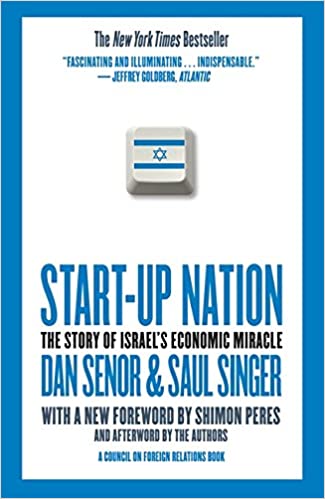
Start-up Nation: The Story of Israel’s Economic Miracle

By Dan Senor and Saul Singer

Start-Up Nation addresses the trillion dollar question: How is it that Israel — a country of 7.1 million, only 60 years old, surrounded by enemies, in a constant state of war since its founding, with no natural resources– produces more start-up companies than large, peaceful, and stable nations like Japan, China, India, Korea, Canada and the UK?

With the savvy of foreign policy insiders, Senor and Singer examine the lessons of the country’s adversity-driven culture, which flattens hierarchy and elevates informality– all backed up by government policies focused on innovation. In a world where economies as diverse as Ireland, Singapore and Dubai have tried to re-create the “Israel effect”, there are entrepreneurial lessons well worth noting. As America reboots its own economy and can-do spirit, there’s never been a better time to look at this remarkable and resilient nation for some impressive, surprising clues.”
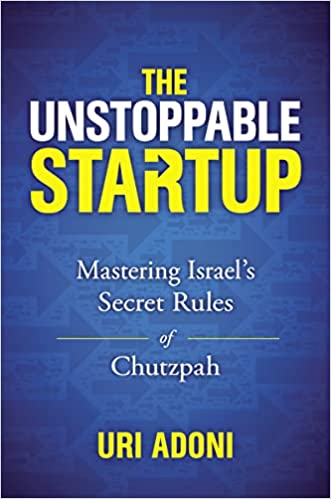
The Unstoppable Startup: Mastering Israel’s Secret Rules of Chutzpah

By Uri Adoni

The Unstoppable Startup: Discover the bold secrets to Israel’s incredible track record of success in this new guide that will help make any startup unstoppable.

More than half of all startups fail – often during the crucial early stages of development when they need to prove their viability on a limited budget. However, when it comes to startup success, one country stands out: Israel.

Even though it is a relatively small country, Israel has one of the highest concentrations of startups in the world, has the highest venture capital per capita, is one of the top countries in terms of number of companies listed on NASDAQ, and is well-recognized as a global leader in research and development.

In The Unstoppable Startup, veteran venture capitalist Uri Adoni goes behind the scenes to explain the principles and practices that can make any startup, anywhere in the world, become an unstoppable one.

Packed with insider accounts from leaders who have realized bold visions, The Unstoppable Startup distills Israeli chutzpah into six operational rules that will help you to:

  • Build an unstoppable team;
  • Foresee the future and innovate to meet its demands;
  • Manage your funding and partnerships through all phases of growth;
  • Dominate the market category you are after or create a new one;
  • Build and manage an early stage investment vehicle;
  • Build and grow a healthy high-tech ecosystem.

Adoni implemented these practices throughout his more than 12 years as a venture capitalist for one of Israel’s most successful venture funds, and he continues to utilize these same proven startup strategies today in metropolitan areas in the US.

The Unstoppable Startup provides readers with insights and operational advice on how to run a startup, and how to overcome challenges that almost every startup faces.”
Chutzpah: Why Israel Is a Hub of Innovation and Entrepreneurship

By Inbal Arieli

Chutzpah: Discover the secret behind how Israel, a tiny country with the highest concentration of start-ups per capita worldwide, is raising generations of entrepreneurs who are disrupting markets around the globe and bringing change to the world.

Dubbed “Silicon Wadi,” Israel ranks third in the World Economic Forum Innovation Rating. Despite its small size, it attracts more venture capital per capita than any other country on the planet. What factors have led to these remarkable achievements, and what secrets do Israeli tech entrepreneurs know that others can learn?

Tech insider Inbal Arieli goes against the common belief that Israel’s outstanding economic accomplishments are the byproduct of its technologically advanced military or the result of long-standing Jewish traditions of study and questioning. Rather, Arieli gives credit to the unique way Israelis are raised in a culture that supports creative thinking and risk taking. Growing up within a tribal-like community, Israelis experience childhoods purposely shaped by challenges and risks—in a culture that encourages and rewards chutzpah. This has helped Israelis develop the courage to pursue unorthodox, and often revolutionary, approaches to change and innovation and is the secret behind the country’s economic success.

While chutzpah has given generations of Israelis the courage to break away from conventional thinking, the Israeli concept balagan—messiness in Hebrew—is at the root of how Israelis are taught to interact with the world. Instead of following strict rules, balagan fosters ambiguity, encouraging the development of the skills necessary for dealing with the unpredictability of life and business. Living with balagan provides Israelis with the opportunity to constantly practice the soft skills defined by the World Economic Forum as the Skills for the Future, as balagan promotes creativity, problem-solving, and independence—key characteristics of successful entrepreneurs.

By revealing the unique ways in which Israelis parent, educate and acculturate, Chutzpah offers invaluable insights and proven strategies for success to aspiring entrepreneurs, parents, executives, innovators, and policymakers.”

Israeli Business Culture: Building Effective Business Relationships with Israelis

By Osnat Lautman

“Read Israeli Business Culture before interacting with new contacts, and return to it whenever necessary for added processing of your cross-cultural experiences.

Author Osnat Lautman uses the word ISRAELI™ as an acronym to depict the general profile of Israel’s business culture:

I Informal

S Straightforward

R Risk-Taking

A Ambitious

E Entrepreneurial

L Loud

I Improvisational

In this revised and expanded second edition of Israeli Business Culture: Non-Israelis will learn about the origins of the Israeli culture, its main characteristics and how to bridge the gap when working with Israelis. Israelis will gain more awareness of how they are perceived by their colleagues, supervisors and subordinates around the globe. Both Israelis and non-Israelis will acquire tools to enhance communication, which is the cornerstone of profitable business in our diverse global economy.”

Thou Shalt Innovate: How Israeli Ingenuity Repairs the World

By Avi Jorisch

Thou Shalt Innovate profiles wondrous Israeli innovations that are collectively changing the lives of billions of people around the world and explores why Israeli innovators of all faiths feel compelled to make the world better. This is the story of how Israelis are helping to feed the hungry, cure the sick, protect the defenseless, and make the desert bloom. Israel is playing a disproportionate role in helping solve some of the world’s biggest challenges by tapping into the nation’s soul: the spirit of tikkun olam, the Jewish concept of repairing the world. Following Start-Up Nation’s account of Israel’s incredibly prolific start-up scene, Thou Shalt Innovate tells the story of how Israeli innovation is making the whole world a better place. Israel has extraordinary innovators who are bound together by their desire to save lives and find higher purpose. In a part of the world that has more than its share of darkness, these stories are rays of light.”

ISRESILIENCE: What Israelis Can Teach the World

By Michael Dickson and Dr. Naomi L. Baum

“From well-known leaders making life-and-death decisions to ordinary people who have overcome incredible loss to do inspirational things, meet the Israelis who thrive against all odds and learn how you can too. ISResilience is a study of a nation that has had to collectively and individually hang tough like no other country on earth. Imbued in Israel’s DNA is the understanding that survival isn’t optional – it’s a necessity. Any Israeli could have given testimony for this book. Israelis routinely carry on with their day-to-day lives not just when things are calm and peaceful but when rockets are launched at them, during official conflicts and wars and unofficial waves of gruesome terrorism. And they don’t just survive – they thrive.

Each chapter of this book profiles a diverse, compelling Israeli personality – some famous, some not, but all exceptional – and traces the characteristic that unites them all. The life lessons extrapolated from these interviewees can teach every one of us to be stronger people. Written by a communications expert and Israel analyst together with a pioneering psychologist in the field of resilience research and treatment, ISResilience brings today’s most in-demand skill to life and shows how we all can benefit from the trait embodied by the nation once admired by Princess Diana as “a plucky little country.” Part-history, part-biography, part-self-help manual, ISResilience is a study of a nation that has had to collectively and individually hang tough like no other country on earth.”

Technion Nation: Technion’s Contribution to Israel and the World

By Amnon Frenkel and Shlomo Maital

Technion Nation: “Science and technology represent our collective tomorrow. And while poor in natural resources, Israel is rich in human resources that have positioned us at the forefront of global advances in the new scientific era through innovation, foresight, creativeness and daring. The seed planted today will yield the world a better place. It was lucky the Technion was found prior to the establishment of the State of Israel, helping us prepare for the future.” Shimon Peres President of the State of Israel

Posted in Israel, Startups | Tagged , | Leave a comment

Overview of the Israeli Startup Ecosystem

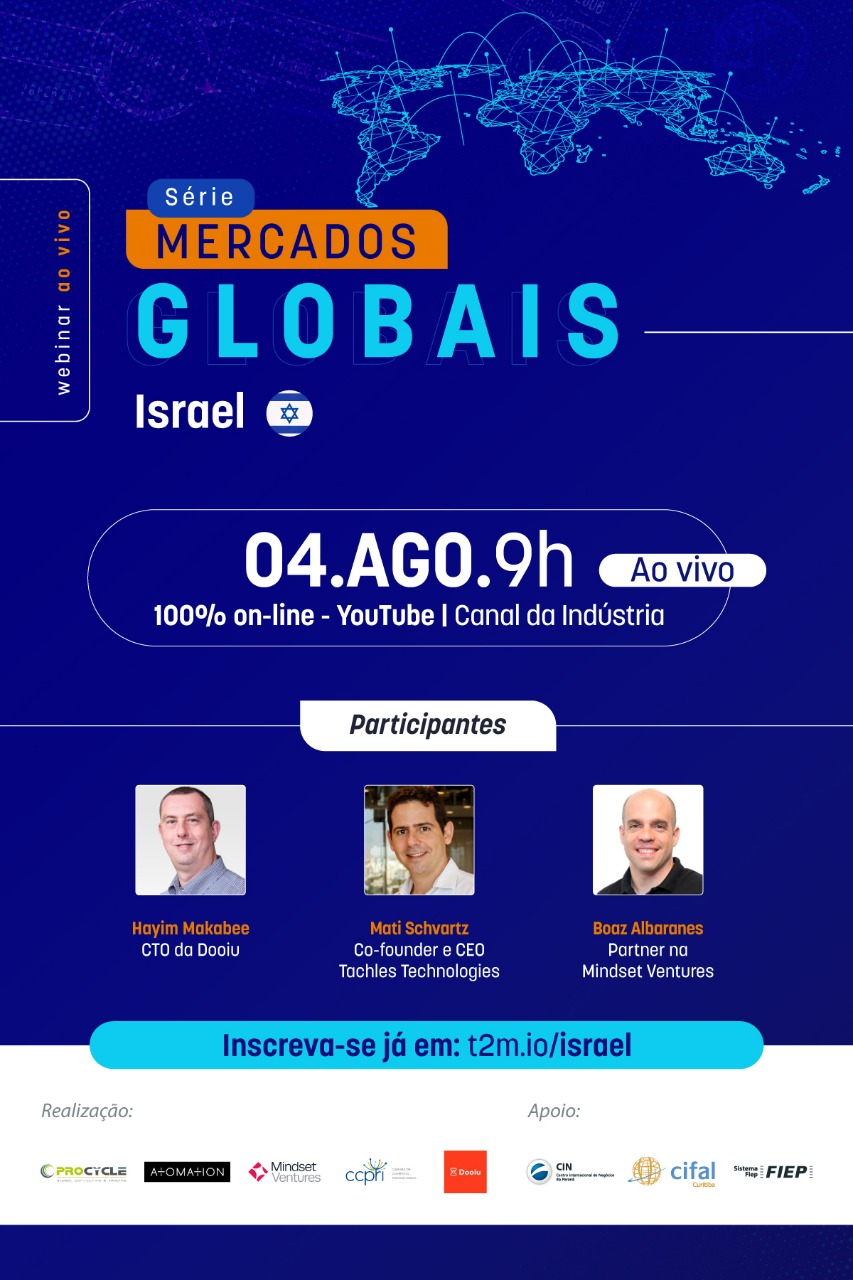
Last week I was invited by the Câmara de Comércio Paraná-Israel – CCPRI to share my insights about the Israeli Startup Ecosystem. Below is the video of my presentation (in Portuguese) with lots of interesting information. I think you will enjoy my presentation if you are interested in learning more about the reasons that Israel is called the Startup Nation, and some of its secrets.

Special thanks to Ricardo Sasson who invited me to share my experience.

Posted in Israel, Startups | Tagged , | Leave a comment

How a Coaching Course can Improve your Leadership Skills

I’m now a certified coach! But no, I don’t have the intention of working as a coach. My goal was to improve my leadership skills.

First of all, I became a better listener. My natural tendency is that I like to speak and express my opinions. In the coaching course I developed the ability to pay attention to what other people are saying. As a leader, this is a very important skill. If you don’t really take in consideration what your team members say, they will simply stop talking to you.

I also learned that very frequently people don’t need your advice. Sometimes the best way to help a person is by asking questions that will conduct this person to finding his/her own answers. In the past, I had the habit of immediately giving my opinion whenever I was presented some problem. Now I understand that it may be much more effective to ask first: “What would you do in this situation?”

I want to thank my teacher, master coach Matías Duek, from the International Kosher Coaching institute, for the passionate lessons in which he shared his knowledge and experience with us.

I also want to express my gratitude to the other participants in this course, that helped made it a real pleasurable experience: Alejandro Goldwasser, Ariel Levin, Federico Pipman, Ilan Orchansky & Rav Richard Kaufmann.

Posted in Efficacy | Tagged | Leave a comment

Interview: Israeli Culture and Tips for New Immigrants

I was invited by the Keren Leyedidut to share my experience with people planning to do their Aliyah (immigration to Israel) from Brazil. Below is the video of my interview (in Portuguese) with many tips and concrete advice for Olim (new immigrants). I think you will also enjoy this interview if you are interested in the Israeli culture in general.

Special thanks to Waldemar Kertsman and Marcos Feuer who invited me to share my experience.

Posted in Israel | Tagged | Leave a comment

How to be happy with your job?

So, do you want to be happy with your job?

I will tell you the secret to become a happy employee: Stop focusing on your own happiness.

Instead of trying to be happy, make sure that your boss is happy with your work and that your team members are happy with your contributions.

Exactly: Focus on the people who work with you and make them happy! As a consequence, you will also be happy.

Why?
– Because when people trust you they will give you autonomy to do your job.
– When your boss admires you he will give you the opportunity to develop your skills.
– And you will have a sense of purpose, because you will be focusing on your contributions instead of focusing on your own happiness.

And Autonomy, Mastery and Purpose are the main ingredients you need to be happy with your job.

This has been exactly my experience working as a Data Science Expert at CodeFuel.
By focusing on my contributions I was granted the opportunity to apply sophisticated Machine Learning models in very interesting projects such as:
– Contextual Targeting
– User Intent Discovery
– Dynamic Creative Optimization
– Real-Time Bidding

I know that I am trusted by my co-workers at CodeFuel. They ask me to solve challenging problems that match my skills. And this makes me happy.

Posted in Efficacy | Tagged | Leave a comment

5 Lessons from my Father-in-Law

My father-in-law Michael Scaba was born in Lebanon, grew up in Israel, participated in 3 wars fighting in the front and later became a successful businessman. I had the luck to marry his daughter, and he became one of my mentors. Below are 5 lessons I learned from him, based on ancient wisdom:

“You are making a hole in the water” = “אתה עושה חור במים”

My father-in-law uses this expression to let me know that I’m trying to do something impossible, or that I’m wasting my time doing something that has no chance to be successful. Of course it is not possible to make a hole in the water, so he uses this advice to let me know clearly and directly that I should focus my efforts on some other initiative.

“A single hand cannot clap hands” = “יד אחת לא מוחא כפיים”

This is his favorite expression when he wants to tell me that I should not try to do everything alone, or, in other words, that I need a business partner. It was important for me to get this kind of advice, because I personally had a tendency to work alone. Today I am much more aware that there are many things we cannot do without partners.

“Don’t take it on your heart, carry it on your shoulders” = “אל תיקח ללב, תיקח על הכתף”

My father-in-law uses this expression very often to help us face our failures and frustrations. Instead of getting hurt when things don’t work as expected, he motivates us to use our strengths to overcome the difficulties. Yes, our heart feels sad when we fail, but we should remember that we have two strong shoulders with the ability to carry this weight.

“It’s not worth it” = “זה לא שווה”

This is a very simple expression, but also very powerful. It happened many times that I explained a situation to my father-in-law and he immediately answered: “It’s not worth it!” First of all, this demonstrates his ability to make fast decisions. But the most important thing for me was learning to say “no”. One of the biggest challenges for an entrepreneur is to be able to reject all kinds of random business opportunities and focus on his/her vision.

“Die honest and not rich” = “תמות ביושר ולא בעושר”

Any business person has many opportunities to make some extra cash by doing things that are not completely legal, like working without receipts or avoiding paying some taxes. Of course these are not big crimes, so it may be difficult to resist the temptation to increase our income. But my father-in-law claims that in the long run a person cannot feel proud of money that he/she has obtained and accumulated dishonestly.

Posted in Efficacy, Israel, Jewish Sources | Tagged , , | Leave a comment

Job Interview Tip: Preparing for the Interview

How do you prepare for a job interview? Most people would say that we need to imagine which questions they are going to ask us during the interview. Thus, we should be ready to answer these questions. For example, there may be very specific technical questions, or we may be asked to describe our previous experience in similar roles.

Of course it is extremely important to be prepared to answer the questions they are going to ask us, but there is another very important aspect: we must get ready for the specific context of this interview. What do I mean by context?

  • What are the specific requirements of the position you are applying to?
  • For which department in the company is this position?
  • Is this position associated with a specific product?
  • What do you know about the company in general?
  • Do you know who will interview you?
  • Do you know how the company is structured?
  • What do you know about the company’s products and services?
  • Who are the company’s main customers?

Let’s discuss each one of these items below.

About the Position

First of all, before the interview, we must remind ourselves of the specific requirements of the position we are applying to. We probably have applied to many other openings in other companies, and each one of them had its unique requirements. Thus, before the interview, we should read the job description again and prepare accordingly. We must remember if this position demands any specific skill, or gives emphasis to some special technology.

About the Department

The position we are applying to is probably related to some specific department or division inside the company. Thus, before the interview, we should try to learn as much as possible about this department. For example, who is the manager? How many people work in this department? How important is this department for the company? Part of this information may be obtained by checking the company’s employees on LinkedIn.

About the Product

In some cases the position we are applying to is related to a specific product or service being provided by the company. Thus, before the interview, we should try to learn as much as possible about this product. What does the product do? What is the core technology being used in this product? For how long has this product been sold? What is the revenue that is being generated by this product? Some of this information may be obtained from the company’s marketing materials, or from the company’s blog or press releases.

About the Company

What can we know about the company in general? When was the company founded? Who were the founders? Who is in the C-level management team? Who is on the Advisory Board? Is this a private company or a public company? How many employees does the company have? Where are its main offices? How fast is the company growing? If it is a public company, what is happening with its stock? Most of this information should be publicly available, and it can be obtained by researching news items and press releases.

About the Interviewers

We should try as much as possible to know in advance who is going to interview us. If we are being invited to a session of interviews, which may have the duration of several consecutive hours, it is legitimate to ask for the detailed interview schedule. Very often the name of the person that is going to interview us can be obtained from the invitation that was sent to our calendar. In this case, we should  research about this person on LinkedIn, learning about the interviewer’s role, background, education and personal interests.

About the Company Structure

It is very important to learn about the company structure, besides the specific department we are going to be interviewed for. What are the other departments and divisions inside the company? Are these different departments co-located or geographically dispersed? For example some companies may have an R&D team in one country and the Sales and Marketing teams located in different countries.

About other Products and Services

We should also try to learn about the other products and services being offered by the company, besides the one we are interviewing for. What are the most successful products and services? Which ones are generating the most revenue? Which ones are the most innovative? Were all these products developed by the company or are they the result of mergers and acquisitions? How strong are these products in relation to the competition?

About the Customers

It is interesting to learn about the clients that are consuming the products and services being provided by the company. Who are the company’s main customers? Is this a business to business (B2B) or a business to consumer (B2C) company? Is the company expanding into new markets? How fast is its customer base growing recently? Again, parts of this information should be publicly available in news items and press releases.

How to use all this information?

If you followed my advice above you did some intensive research and learned a lot about the company, its structure, its products and customers. You should also know exactly who is going to interview you, for which department, and for which product. How can you benefit from knowing all this information? There are several ways:

  • Personal connection with the interviewer
  • Relating this position to your previous roles
  • Demonstrating your knowledge
  • Making good questions

Let’s discuss each one below:

Personal Connection with the Interviewer

All the information you have learned about the interviewer can help you get much closer to him/her and generate potential conversation topics. For example, perhaps you have discovered that you and the interviewer have studied in the same college, or that you have worked in the past for the same company, or that you share some personal interests. These are opportunities to create a personal connection with the interviewer, which obviously you can benefit from.

Relating this Position to your Previous Roles

All the information you have learned about the position, and the respective department and product, may help you show how it is similar to previous roles you had in the past. For example, you can describe how in the past you have worked in the development of a very similar product, which used the same technology. Or you can say that you have worked for a company that operated in the same market with the same customer segment. These similarities certainly make your previous experience more relevant.

Demonstrating your Knowledge

You will probably have several opportunities to demonstrate your knowledge about the company during the interview. For example, if the interviewer is giving you some explanation about the company’s structure, this may be an opportunity to say: “I read that you have recently acquired startup company X” or that “I saw that you have recently opened new offices in Dubai”. These comments, if accurate, will certainly be very impressive.

Making Good Questions

In general, during the interview, the interviewer will give you the opportunity to ask your own questions about the role, the product or the company. This is an additional opportunity to demonstrate your knowledge. For example, you can say: “I saw that you are developing a new product Y and I’m very curious about its usage of Artificial Intelligence”. Such questions will also make a very good impression, but of course you should only ask questions if you are genuinely interested in knowing the answer.

The Bottom Line

If you follow my advice above, you will certainly be well prepared for the interview, and you will also have the opportunity to demonstrate that during the interview, causing a very good impression that will increase your chances to be hired. This level of preparation shows clearly that you are really interested in getting this job.

Actually, if you follow my advice above, you will certainly be an outstanding candidate, because most people are too lazy to do that. Good luck!

Posted in Efficacy, Hiring | Tagged , | Leave a comment

Job Interview Tip: Describing Your Previous Experience

If you are looking for a new job, it is very important to be prepared for the job interviews you are going to face. During these interviews, you probably will be asked to talk about your previous experience in projects that are relevant to the position you are applying to.

Hence, the question: How should you describe your previous experience? What are the aspects that you should emphasize?

In my opinion you should talk about:

  • The project itself
  • The role you had in this particular project

Regarding the project, you should explain why it was:

  • Important
  • Interesting
  • Challenging

Regarding your role in the project, you should explain your:

  • Contribution
  • Achievements
  • Growth

Let’s discuss each one of these items in more detail below.

Important

Why was this project important? Here you should explain that this was not just another project. Perhaps it was a project for the biggest customer, or for a new customer. Perhaps it would enable your company to enter a new market, or to reach a new segment of users. A project is important when it is creating new opportunities. The fact that you were chosen to participate in such a project tells something about your abilities.

Interesting

Why was this project interesting? Here you should explain that there was something special about this project. Perhaps you would be the first to try a new technology. Perhaps the project required innovative approaches, or the exploration of new strategies. A project is interesting when it requires imagination and creativity. The fact that you participated in such a project may mean that you have a unique experience.

Challenging

Why was this project challenging? Here you should explain that this project was not trivial, that it had some difficult aspects. Perhaps you had to work with very limited resources, or with many constraints. Perhaps there were special regulations, or the customer had very unique requirements. A project is challenging when it requires sophisticated, non-standard solutions. The fact that you were able to overcome these challenges is a special achievement.

Contribution

What was your personal and individual contribution to this project? What was your role, your authority and your responsibility? Perhaps you lead a team, or were responsible for coordinating efforts with other departments in the company?  Perhaps you had to implement a specific component, or design a new interface? Your contribution in this project is a reference to the responsibilities you may undertake in your new job.

Achievements

What were your main achievements in this project? Here you focus not on what you did or how you did it, but you describe the results. So for example you can say that you increased the profit and reduced the costs. Perhaps you were responsible for improving the efficiency of a system or for defining a new process. Your achievements should indicate that you delivered results above the expectations, that you overperformed.

Growth

How did you grow as a consequence of this project? What was the impact in your professional career? Perhaps you were promoted, or perhaps you got more responsibilities? What did you learn in this project? How did you expand your knowledge and your experience? Did you acquire new skills? The successful execution of a project should always have a positive impact on the professionals that executed the project.

In Summary

When doing job interviews, you certainly will be asked to describe previous projects.

Regarding the project, you should explain why it was:

  • Important
  • Interesting
  • Challenging

Regarding your role in the project, you should explain your:

  • Contribution
  • Achievements
  • Growth

Good luck! Please feel free to share your experience in the comments below.

Posted in Hiring | Tagged | 1 Comment

VUCA: Volatility, Uncertainty, Complexity and Ambiguity

It’s January 2022, we are 2 years after the beginning of the Covid Pandemic, and the feeling is that we are living in a VUCA world: it is characterized by high-levels of volatility, uncertainty, complexity and ambiguity.

  • V = Volatility: the nature and dynamics of change, and the nature and speed of change forces and change catalysts.”
  • U = Uncertainty: the lack of predictability, the prospects for surprise, and the sense of awareness and understanding of issues and events.”
  • C = Complexity: the multiplex of forces, the confounding of issues, no cause-and-effect chain and confusion that surrounds organization.”
  • A = Ambiguity: the haziness of reality, the potential for misreads, and the mixed meanings of conditions; cause-and-effect confusion.”

We do not have much control over the events that are happening in the world. Besides the profound changes caused by the Pandemic itself, there are also the unintended consequences of the accelerated development of new technologies, the proliferation of military conflicts and more frequent natural disasters caused by Climate Change and Global Warming.

As an individual in January 2022 this probably means that you have dozens of friends and acquaintances who were recently sick with Covid, that you don’t really understand all the implications of NFTs and the Metaverse, that you are concerned about Russia invading Ukraine, and that you are experiencing some extreme weather during this winter (or summer).

In my opinion, in such situation each person should try to increase as much possible the stability of his own life. It’s true that we have no alternative other than being part of this VUCA world, but this does not mean that we should have a VUCA life.

What can we do to avoid having a VUCA life? I share some ideas below.

Volatility

To reduce volatility, we may need to avoid unnecessary change in our lives. Perhaps this is not the best time to change jobs, take a loan to buy a new car, adopt a pet, commit to a new volunteer activity, or start a new side hustle. All of these ideas may be excellent at the right time, but probably not when a person is looking for more stability.

Another aspect of volatility is Information Overload. The different social networks we use may expose us to a huge number of posts in a very short period of time. To reduce volatility, instead of consuming these random pieces of content being shared by our contacts, we should select the subjects we want to learn about, and then search for the best sources about them.

“What we choose to focus on and what we choose to ignore – plays in defining the quality of our life.” – Cal Newport

Uncertainty

To avoid uncertainty, we need to focus on activities that have a more predictable outcome. For some people this would mean looking for lower-risk investments. For others this would mean choosing a fixed-salary job instead of being a freelancer with variable income. If “profit is a reward for risk taken in business”, predictability means taking lower risks to reduce uncertainty.

A different way to reduce uncertainty is focusing on long-term projects. In general it may be difficult to produce visible results in a short period of time. But, thanks to the Compound Effect, the application of consistent effort through an extended period of time is guaranteed to generate results. Even very small steps accumulating over a long time can make a big change.

“Most people overestimate what they can achieve in a year and underestimate what they can achieve in ten years.” – Bill Gates

Complexity

To reduce complexity, we need to avoid inter-dependencies among issues that should not be related to each other. For example, we should reduce the interference between our work and the rest of our lives, creating a clear separation between work time and family time. We should not have to choose between answering an email or helping our kids with their homework.

Another way to reduce complexity is to apply the logic principle called Occam’s Razor: “Among competing hypotheses, the hypothesis with the fewest assumptions should be selected.” In other words, if we are looking for an explanation for something we can’t understand, we should check first the simplest explanation, because it will be easier to validate its correctness.

“Keep it simple, as simple as possible, but not simpler.” – Albert Einstein

Ambiguity

To avoid ambiguity in our lives, we need to define things. For example, regarding the tasks we need to do, we should define our goals, write a TODO list, and specify our priorities. As important, regarding our decisions, it is necessary to define the information that is required to make each decision. We should not try to make important decisions if we lack the details.

It is also extremely important to avoid ambiguity in our relationships with other people. In the office, if we are assigned several tasks, we must ask our manager to define their priorities. At home, if our spouse expresses dissatisfaction with our behavior, we need to clarify the reason. In the industry, this identification of the real issue is called Root-Cause Analysis.

“The mark of a mature, psychologically healthy mind is indeed the ability to live with uncertainty and ambiguity, but only as much as there really is. Uncertainty is no virtue when the facts are clear, and ambiguity is mere obfuscation when more precise terms are applicable.” – Julian Baggini

Opportunities in a VUCA world

I wrote this post thinking about people who are looking for more stability in their lives. But some people may claim that the VUCA world is actually fascinating, because it is creating so many new opportunities.

These are some of the ways we can benefit from a VUCA world:

  • Volatility: the fast changes create lots of new opportunities. In particular the development of new technologies enables the implementation of new business ideas that were impractical in the past, and renders previous business models obsolete.
  • Uncertainty: people who are willing to take the risks may obtain big profits from their investments. When someone leaves a stable corporate job to found a startup company, this person is embracing uncertainty by focusing on the potential of a huge reward.
  • Complexity: in a complex world we need more experts that are able to provide guidance and orientation to others. The more complex a subject is, the more scarce are the people who really understand it, and thus they become more valuable professionals.
  • Ambiguity: in order to face ambiguity we need more analysts, people who are able to interpret the reality and provide actionable insights. It is a very valuable skill to be able to foresee the consequences and implications of the decisions being made.

In general, companies will need qualified professionals to help them deal with all these new forms of volatility, uncertainty, complexity and ambiguity. These roles cannot be automated before these professionals define new processes.

Conclusion

It is a fact that we live in a VUCA world. In this article I have presented some ideas of how we may be able to reduce the volatility, uncertainty, complexity and ambiguity in our personal lives. But I’ve also presented some ways we can benefit from a VUCA world in our professional lives. Each person needs to make an individual choice of how much of these aspects are desirable in their lives, trying to control them when possible.

I hope you have enjoyed reading this article. It will be a pleasure to hear about your own experiences in the comments below. 

A personal note: this article was written while I was isolated at home, sick with Covid. Now I’m feeling better, thank G’d.

About focus (avoiding volatility):

About long-term projects (avoiding uncertainty):

Posted in Efficacy | Tagged | 2 Comments

Talk on Adaptable Design Up Front in Spanish

This month I was invited by the FaMAF and Eclypsium to talk about “ADUF – Adaptable Design Up Front”. The FaMAF is the Faculty of Mathematics, Astronomy, Physics and Computing of the National University of Cordoba, in Argentina. Eclypsium is a company focused on Firmware and Hardware Security which has an R&D center in Cordoba.

Synopsis: This talk tries to answer the question: “How much Design Up Front should be done in an Agile project?” Hayim presents his approach of Adaptable Design Up Front (ADUF), describing its rationale, applications in practice and comparison to other approaches such as Emergent Design.

Bio: Hayim Makabee was born in Rio de Janeiro. He immigrated to Israel in 1992 and completed his M.Sc. studies on Computer Sciences at the Technion. Since then he worked for several hi-tech companies, including also some start-ups. Currently he is the CEO at KashKlik. He was also a co-founder of the International Association of Software Architects (IASA) in Israel. Hayim is the author of a book about Object-Oriented Programming and has published papers in the fields of Software Engineering, Distributed Systems, Machine Learning and Behavioral Economics.

These are the original slides of Hayim’s presentation:

ADUF – Adaptable Design Up Front from Hayim Makabee

Here is the video of the entire talk (in Spanish):

Special thanks to Daniel Gutson and Nicolás Wolovick who invited me to give this talk.

Feel free to share your comments below. Thanks!

Posted in Adaptable Design, Agile, Software Architecture, Software Engineering | Tagged , , , | Leave a comment