I’m happy to see so many software developers who are enthusiastic about Agile methods. It’s nice when people enjoy their work. However, I think there is a problem: Some teams are giving too much emphasis to Project Management activities, while at the same time they appear to have forgotten some basic Software Engineering practices. In this post I will present some examples of this lack of balance between the two.
Drawing Burn-down Charts vs. Drawing UML Diagrams
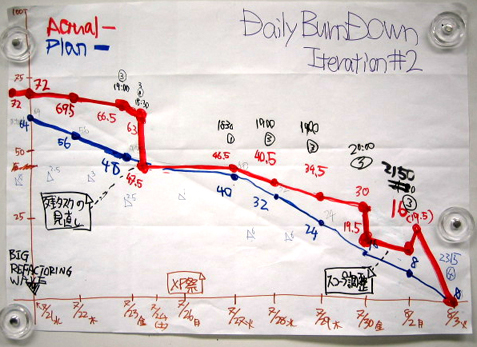 Burn-down charts help us track the progress being done. They present clearly how much work has been completed, and how much work is left until the end of an iteration. By taking a look at the chart, it’s easy to know if the project is behind or ahead of schedule. But the burn-down chart tells us nothing about the quality of the software being produced, and neither has it any value after the iteration has been completed. Burn-down charts are a project management artifact, they are not a deliverable of the software development process.
UML diagrams are an essential part of the software development process. They are required by the person doing the design to conceive and compare several alternatives. They are needed to present these alternatives and allow design reviews. They serve as part of the documentation of the code that is actually implemented. Drawing UML diagrams is a software engineering activity, and these diagrams are part of the deliverables of the software development process.
However, it seems that some Agile programmers invest very few time drawing UML diagrams. Perhaps they think that these diagrams are only needed in Big Design Up Front, and not when you do Emergent Design or TDD. In my opinion this is a mistake. If you spend more time drawing burn-down charts than UML diagrams, then you are doing more project management than software engineering.
Estimating User Stories vs. Computing Algorithms Complexity
 In an Agile project the User Stories are the basic unit of work, and it is very important to estimate the effort that will be required to implement these stories. Techniques such as the Planning Poker were invented to make this estimation process as accurate as possible, since iterations are very short and there is not much margin for errors. However, the time spent in effort estimation does not affect the quality of the software. Effort estimation is a project management activity.
Professional software developers must be able to compute the complexity of the algorithms they are adopting in their systems. Actually, they should base their design decisions on the different time and space complexities of diverse algorithms and data structures. They should understand the differences between best, worst, and average case complexities. Computing algorithm complexity is a software engineering activity, essential to assure the quality of the systems being developed.
However, it seems that some Agile programmers don’t ask themselves many questions about the complexity of the algorithms they are using. They just go to the library and choose the Collection with the most convenient API. Or they always choose the simplest possible solution, because of KISS and YAGNI. But if you spend more time estimating user stories than computing time and space complexity, then you are doing more project management than software engineering.
Measuring Velocity vs. Measuring Latency and Throughput
 In Agile projects, the team members are constantly measuring their Velocity: How many units of work have been completed in a certain interval. Of course people want to be as fast as possible, assuming that your velocity is an indication of your productiveness, efficiency and efficacy as a software developer. But the velocity gives us no indication of the quality of the software being produced. On the contrary, it is common to see Agile teams working very fast on the first iterations just to slow down considerably when they start doing massive Refactorings. Thus measuring the Velocity is just a project management activity with dubious meaning.
Many software developers today are working on client/server systems such as Web sites and Smartphone Apps. These systems are based on the exchange of requests and responses between a client and a server. In such systems, the Latency is the time interval between the moment the request is sent and the moment the response is received. The Throughput is the rate the requests are handled, i.e., how many requests are responded per unit of time. In client/server systems it is essential to constantly measure the latency and the throughput. A small code change, such as making an additional query to the database, may have a big impact on both.
However, it seems that some Agile programmers are constantly measuring their velocity, but they have absolutely no idea of what are the latency and throughput of the systems they are developing. They may ignore non-functional requirements and choose simplistic design alternatives that have a huge negative impact in the system’s performance. Thus if you measure your own velocity more frequently than you measure latency and throughput, you are doing more project management than software engineering.
Meetings and Retrospectives vs. Design and Code Reviews
 Agile projects normally have daily meetings to discuss how the team is making progress: What have been done, what will be done, are there any obstacles. These meetings do not include any technical discussion. Projects may also have retrospective meetings after each iteration, with the goal to improve the process itself. These meetings are project management activities, they do not address software quality issues.
Design and code reviews focus on software quality. In a design review, an alternative should be chosen based on non-functional quality attributes such as extensibility and maintainability. Code reviews are an opportunity to improve the quality of code that should be already correct. Code reviews should also be used to share technical knowledge and make sure that the team members are really familiar with each other’s work. These kinds of reviews are software engineering activities, with a direct effect on the deliverables of the software development process.
However, it seems that some Agile programmers focus too much on the process and not enough on the product. Successful software development is much more than having a team managing itself and constantly improving its processes. If the quality of the software is decaying, if technical debt is accumulating, if there is too much coupling among modules and if the classes are not cohesive, then the team is not performing its goal, no matter how efficient the process seems to be. If you are spending more time in stand-up and retrospective meetings than on design and code reviews, then you are doing more project management than software engineering.
In Summary
Drawing burn-down charts, estimating user stories, measuring your velocity and participating in retrospectives are project management activities. Drawing UML diagrams, computing the complexity of algorithms, measuring latency and throughput and participating in design reviews are software engineering activities. If you are a software engineer, you should know what is more important. Don’t let your aspiration to become a Scrum Master make you forget the Art of Computer Programming. Good luck!